
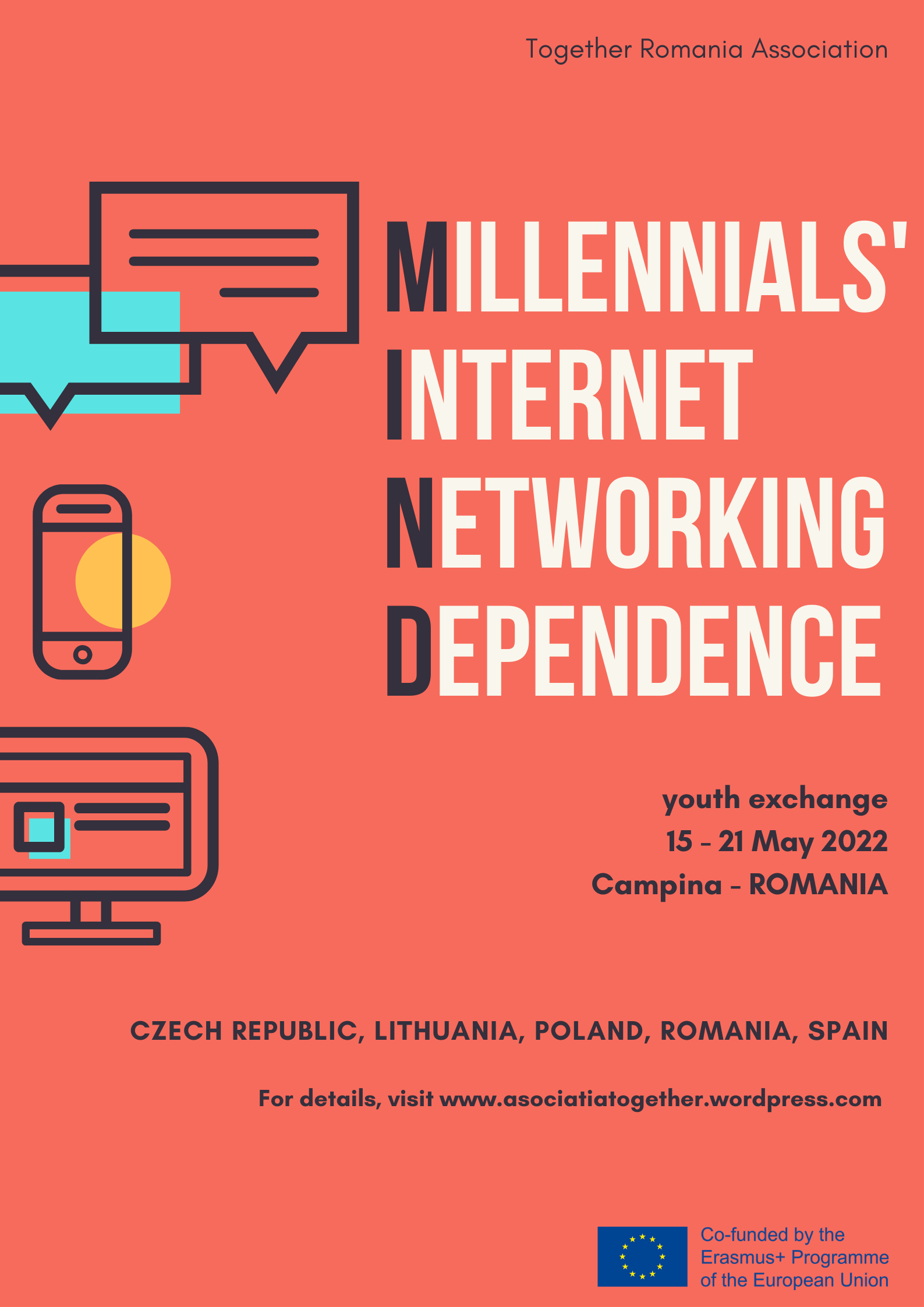
MIND – Millennials’ Internet Networking Dependence, Campina 2022
Today’s teens have never lived in a world without the internet. They are often more tech-savvy than adults and they embrace new trends and technologies. Youngsters increasingly use the Internet for communication, education, entertainment, and other purposes in varying degrees. Given their vulnerable age, they may be prone to Internet addiction. Even this, some youngster are aware that usage can evolve into an obsession, and this obsession can become an addiction. Real life can begin to take a back seat to online time. Based on the experience and discussion with youth local community, we have seen that the youngsters are exceptionally vulnerable and receptive during this period and can become drawn to the Internet as a form of release. They are especially attracted to new technological methods of communication, which offer interaction with others and at the same time provide anonymity, impression of belonging to a community, and a sense of social acceptability.
After recognising the existing issue in our local community, we have found statistics, which are showing that this issue is also recognised worldwide. It has been estimated in March 2019, that a number of 4,346,561,853 of people are internet users, from a total number of 7,716,223,209 (Internet World Stats). It means that a rate of 56,3% of population is using the internet daily. Internet and social media addictions continue to grow as our dependence on technology increases. There has been estimated that 210 million people suffer from internet and social media addictions worldwide. Most of the millennials are not aware of the fact that they are exposed to different risks everyday. Young people can become more and more affected if they don’t realise how exactly the internet and social media channels are influencing their thinking and behaviour. We are expecting an increase of technology in the following years.
Main goal: our goal was not to stop youngsters from using the Internet but rather to instruct them how to use it in a safer and smart way since the online world is part of our lives and can help us all in a lot of different ways.
Objectives:
- to empower 30 participants to protect themselves against the risks they may encounter on digital and social media platforms, during mobility;
- to develop skills and abilities for correct and healthy use of the Internet by 30 participants both in school activities and in personal life till the end of the mobility, using non-formal education;
- to raise awareness among 200 participants on the risks of the Internet – such as cyber bullying, Internet addiction, hacking, identity thefts, false identities, etc., until the end of the project.
The participants of our project were 30 young people aged 18-25, coming from Romania, Poland, Czech Republic, Spain and Lithuania. The Millennials are very exposed to social media addictions everyday. Our teams worked together for developing the concept of our project. We have observed this addictive attitudes in our local communities. We have managed to come together and work for this project, focusing on social media addictions and its consequences. We made our best efforts to actively involve individual teams and all participants without exception, in the project planning process. As young people who have undertaken cooperation with international character, we implemented our project at all its stages, from the preparation of the action, through the implementation of our exchange, and on promotion and dissemination of results.
 Together Romania Association