.
THE PRINCIPAL CAPITAL OF EUROPE: THE YOUTH!
.
.
Short description of the project:
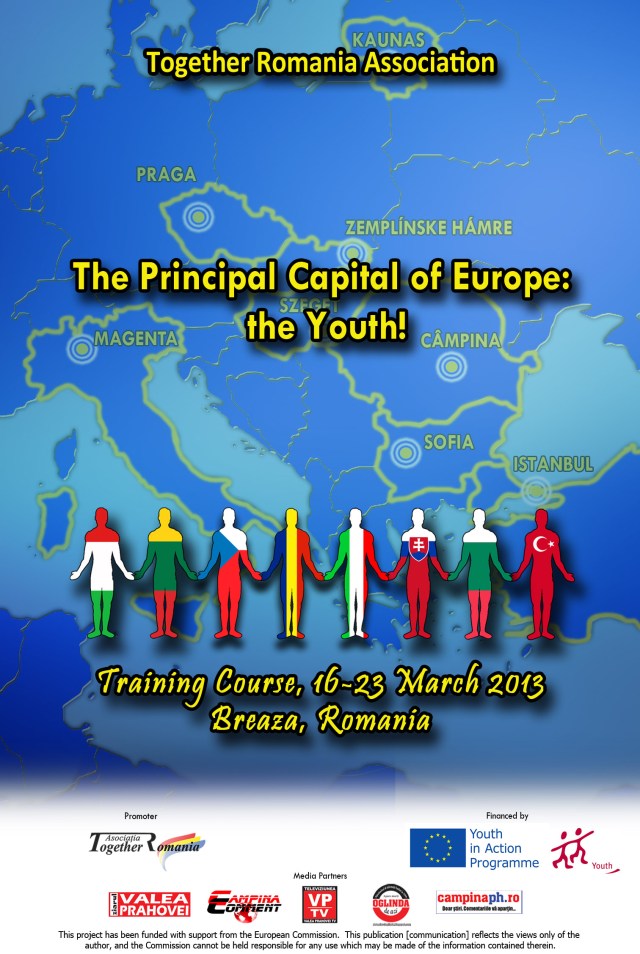
The training course aims to create consciousness and action about the importance of youth as the most valuable saving (the social capital) of the Europe. Social capital is an innovative idea in different sciences generally referring to connections within and between social networks. In that training course, we will focus on different aspects of social capital phenomenon on combating and overcoming poverty and social exclusion. With the guidance non-formal learning methods, we will learn and practice about social capital as a concept, its relationship with discrimination in society, economical unweighted distribution, human resource management, volunteerism (including European Voluntary Services), social networks, cooperation among non-governmental organizations and inclusion strategies. Romania will be the host country for this important training course with its 7 partners: Turkey, Czech Republic, Slovakia, Lithuania, Italy, Hungary and Bulgaria, which will send three participants who are youth workers, trainers or volunteers, so in total 24 participants, 2 leaders, one facilitator and 2 staff members. The project will have 7 working days and will take place in Breaza, Romania.
.
What are our main aims and objectives of the activity?
- Informing participants about the countries in Europe together with their income states, poverty and unemployment rates and youth population,
- Increasing the awareness of participants regarding new job opportunities,
- Informing participants about the concept of “synergy” that keeps its importance to form social capital and annihilate exclusion,
- Informing participants about “Human Resources Management” and its importance,
- Informing participants about “social networks”, which is one of the social capital tools, on the internet,
- Informing participants about Europe Voluntary Services (EVS) in the formation of social capital and combat with exclusion,
- Helping social capital formation by encouraging cooperation between individuals,
- Enhancing social capital by helping individuals of non-governmental organizations of different countries recognize each other,
- Introducing our culture and creating the awareness of different cultures in different countries,
- Contributing to the development of youth programs and improving quality in youth projects.
.
Methodology
Non formal education = workshops, presentations, information space, exchange of experience, discussions, learning by doing and experience learning, simulation exercises, intercultural learning.