
NO Bullying!, pilot project, Campina 2018
In Romania, a survey (Curelaru et al. 2009) done on 1100 youngsters aged 15-21 years in 35 schools reported frequent bullying in various forms of physical, verbal and relational bullying, ranging from offence (17 %) to gun threatening (5 %), with more physical bullying amongst boys and relational bullying amongst girls. So bullying is a present problem, even increasing by the social media and social networks.
Teenage bullying is a very real problem in local schools. And it isn’t always physical. There are many different types of bullying, including verbal and emotional bullying. These types of bullying, though more subtle than physical bullying, can still have a large impact on a pupil. Additionally, with the Internet now becoming a huge part of many teens’ lives, it is no surprise that cyber bullying is seeing an increase.
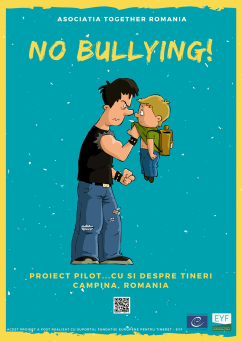
The project we mention that the idea started was our last EYF local project, called Gender Equality. Because this project involved more than 100 local pupils and most of the activities were done in the local high schools, we had a strong feedback from the local youngsters regarding the local youth needs. One of the most discussed and identified as a real problem, in all 3 local high schools that took part in the project, was verbal and physical aggression.
Main objectives of our project are to learn to recognize bullying, violence and harassment, get better the understanding and its impact in community; to develop anti-bullying policies recommendations, action plans and strategies for protection and empowerment of school communities’ actors in responding to violent and anti-social behaviours and to improve bullying competences of participants. Another interesting aspect of the project is the direct contribution of locals (authorities, high-school, NGOs) in a project with “whole approach” involving youngsters, pupils, teachers and community. A special focus will be on the understanding of the values of the “third” position that offers potential strategies to interrupt bullying as well as to prevent it.
This project was done with the support of the European Youth Foundation.

